Showing posts with label Schlumbergera bridgesii. Show all posts

Tuesday, December 2, 2014

The Story Behind the Houseplant


I write articles for Michigan Gardener and Michigan Gardening magazines. Of course, my Mom is proud of me, and tells everyone she knows. (It's nice to have a cheering section.) Her friend Lorna reads my articles and asked my Mom if the next time I came up to visit, I would like to come see her Christmas cactus. I said, "Yes, please." Today my Mom and I went to visit her and I was blown away by the size of not only her Christmas cactus, but  also her Easter cactus and her two Hoyas. She told me she received a peice of the Christmas cactus from her mother-in-law in 1956 after her wedding. She said I was more than welcome to come see it in bloom next time I'm up north. I can't wait! 
The Easter cactus, Rhipsalidopsis gaertneri, is also huge and old. I had my Grandmother's, which unfortunately died this year. 
Her Hoya carnosa compacta or Hindu rope plant is huge but hasn't flowered for her. I think it needs more light and she needs to move it to a brighter location for it to bloom. 
The other Hoya she has is, as far as I can tell, Hoya memoria, formerly Hoya gracilis. She also received this plant from her mother-in-law and estimates it is approximately 54 years old. It hangs in her kitchen nook area near a north window and about 8 feet from an east window. It blooms reliably for her. I was amazed it blooms with only that amount of light.
I saw one like this in a hobby shop in Tecumseh, Michigan and the owner gave me a cutting. I also had a customer bring in one of these to our nursery to have me repot it. It had been in the same pot since the early 1960's. I couldn't believe it! It was in a McCoy pot from that era, though, so it made sense. 
The pot had so much salt buildup from fertilizer, the first thing I did was clean the pot with vinegar to get the crud off.
The poor plant was very rootbound and soil was very scarce. The owner thought it needed a bigger pot, but as hoya like to be rootbound (they flower better that way) I decided to put it back in the same container with some fresh soil.


I love the speckled leaves of this Hoya! I have started new plants from cuttings the customer and the hobby shop owner gave me. I can't wait for mine to get big enough to flower.
I love it when I am privileged to help people with their houseplants, most especially when they trust me with plants that have been in their family for years. I have to admit, though, I do get nervous handling these special plants.  I have some sentimental plants, as well, that I would hate to lose. If you have a plant that has been in your family for years and is now your responsibility, please share it with me in the comments. I love the stories! 

Wednesday, January 2, 2013

The Real Thing

Aunt Gloria's Christmas cactus.
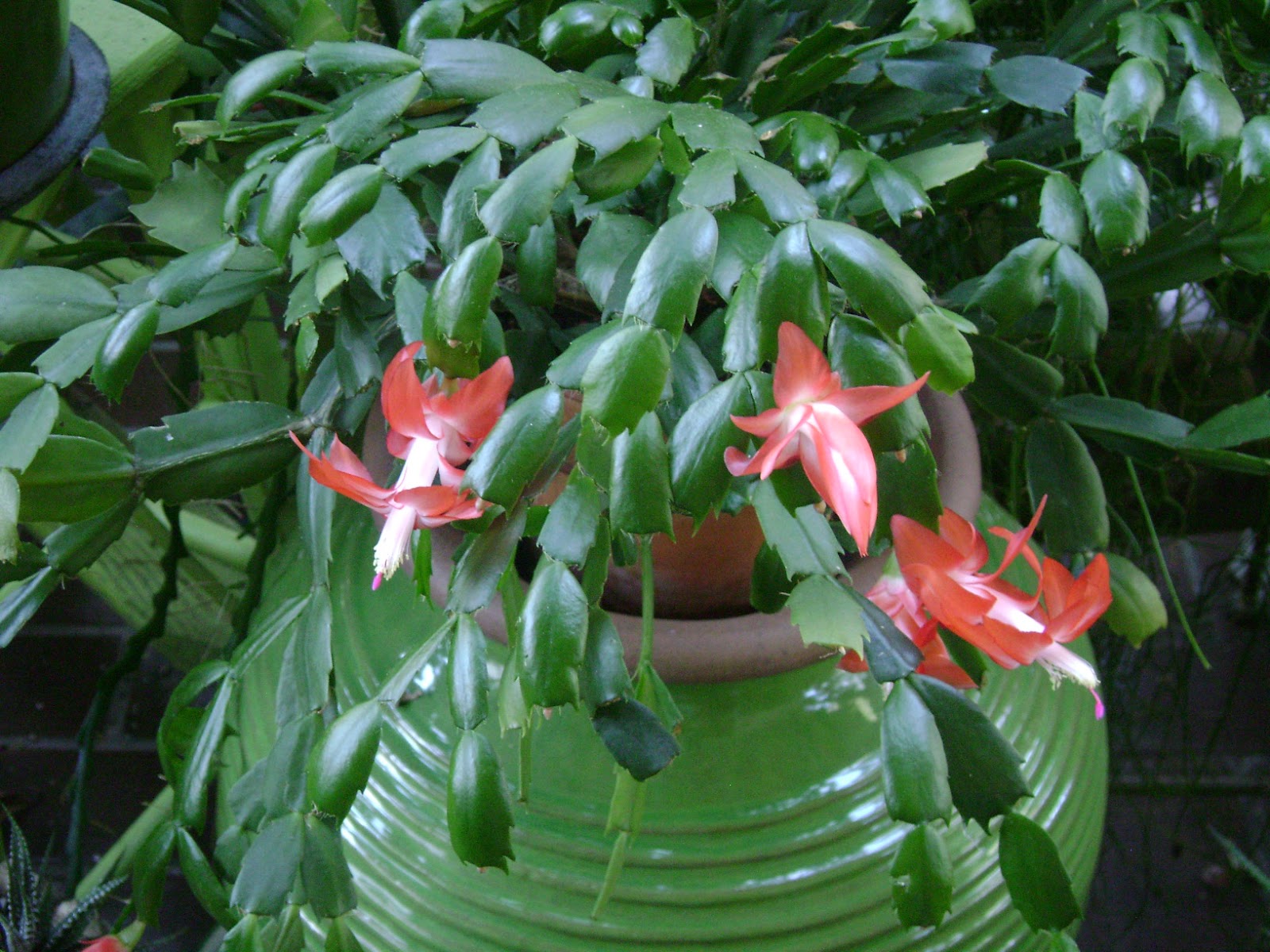
Most people aren't aware there is a difference between Christmas cactus and Thanksgiving cactus. I had only seen the latter, until last December.  I saw one at the Winn, MI antique store and then the same week, at my Aunt Gloria's home. Of course, usually everyone just calls both Christmas cactus, but that isn't correct. How can you tell the difference, you ask? The true Christmas cactus (Schlumbergera bridgesii) blooms later in the year than the Thanksgiving cactus (Schlumbergera truncata). The easiest way to tell them apart, though, is the shape of their stem segments or phylloclades (cladodes). The Latin for leaf is phyllo- and for branch is -clade. They both have these flattened stem segments, but the Thanksgiving cactus has segments with small pointed appendages, whereas the Christmas cactus has rounded edges. By the way, they really are cactus. Epiphytic cactus, as they grow in Brazilian rainforests in trees, but cactus none the less. 

Christmas cactus segments
Thanksgiving cactus segments.
I immediately asked for cuttings from my Aunt and received them. I let them dry for a few days and potted them up in a well-drained soil. Of course, December isn't the best time to start cuttings, but I have them under lights, and dipped them in rooting gel. If they don't take, I know where to get more. It is best to trim your cactus after blooming, in the Spring and propagate the cuttings at that time. Every time you take a cutting, two segments will grow from that point, thus ensuring twice the amount of flowers next year. So, even if you don't want to propagate your plant, trim your plant lightly to stimulate more segments to grow.
  I discovered the cactus came from my Grandma Elnore Eldred, who received her plant from my Great-Grandma Alice Eldred, so this cactus has been in our family for a very long time. I wish I could find out where it came from before that, but no one is still alive who would know.  I am so excited to have a plant that has been in my family for so long. 

Family Christmas cactus
Christmas cactus segments and flower
Christmas cactus
 I have a picture of my Great- Grandma Christina Baldwin on my Mom's side, who is photographed in front of a huge cactus,  but alas, no one has a piece of it left. The picture was taken in March of 1949. Quite often, these plants will bloom more than once and this one definitely has buds and blooms.

Great-Grandma Baldwin with Christmas cactus 1949
The owner of the Winn antique shop said his cactus was very old, and very big until last year, when he noticed it was dropping a lot of its stems. When he investigated the container, he found that the drainage hole had become blocked and the plant was waterlogged. This was a hard lesson to learn. This can happen because the roots fill the hole, or because the salt buildup from fertilizer can accumulate and block it. It is always a good idea, especially with very old plants, to check the drainage hole occasionally and make sure it is free of roots and salt build up.  Luckily, after letting it dry out and re-potting, he saved his plant.

Christmas cactus at antique store in Winn, MI
Whether you have a Christmas or Thanksgiving cactus, keeping it growing and passing it down through the generations is a great family tradition and one your kids and grand kids will appreciate.


Pink and Red Thanksgiving cacti in full bloom

Orange Thanksgiving cactus
 

Friday, November 18, 2011

Holiday Cactus

             
 I love this time of year. The holiday season is here, and it's time for the Thanksgiving cactus to bloom. Some of mine are in bloom, but the Christmas cactus are just budding up. What is the difference? Thanksgiving cactus, or Schlumbergera tuncata, is also called claw cactus, because it's stem segments have pointed teeth on them. The Christmas cactus, or Schlumbergera bridgesii, have stem segments that are more rounded. Usually they are just called Christmas cactus or holiday cactus. Whatever you call them, they are beautiful, holiday-time blooming plants.   Most of these pictures are from last year, but they are all in bud, and the peach one is blooming right now. Other than my African violets, I think they are the most beautiful blooming houseplants.

Let's talk about them for a minute. They are cactus, but not the kind you usually think about. They are jungle cactus, growing in the forks of trees in the jungles of South America. They are epiphytic, meaning they live on trees, but are not parasitic, meaning they do not draw nourishment from the plant they are on. Their nourishment comes from the debris that gathers in the forks they are growing on. They grow like orchids and staghorn ferns, just to name a couple.
Because they grow on trees, they would prefer not to be in full sun, even in the house. If taken outside for the summer, place them in a shaded, or filtered sun area. Their biggest requirement is warmth and lots of humidity. They are from the jungle, remember. If they are kept too cold, the yellow and white varieties will have a pink tinge to them. A well-drained soil is a must. Being epiphytic, they do not grow in soil per say, but in the debris that collects in the forks of the trees..
The biggest problem seems to be getting them to re-bloom. The key is too keep them dry in the month of September. Cool night temperatures in the fall help trigger blooming as well. The shorter days and longer nights of fall are also an important factor, and keeping them in the living room where the lights are on all evening can hinder blooming. Many people place them outside for the summer and keep them out until the temperatures are in the 50's and even high 40's. Mine stay inside, so I don't turn the heat on in my sun room until it's quite cold. I've never had my plants not bloom, so I lean toward the cool temps. I'm not always on top of the water, either, so that may also factor in. Following  are a few pictures of my plants in bloom. What's not to like?


November 16, 2011


Many people have a plant that belonged to their grandma, who got it from their grandma, and so on. This is a long lived plant and one that is easily shared. When pruning them in the spring, take the cuttings and root them in soil, and you can share your plants with family and friends. Pruning will increase the blooms next year as well, so its a win, win situation. You increase the blooms of your plant and share a great plant with someone else!