Showing posts with label Mexico. Show all posts

Thursday, December 26, 2013

Poinsettias are Not Blase!


Who says poinsettias are blase? Well, a lot of people actually. I was one of those people, but have become a huge fan. Huge!
 I love them on antique postcards.......


on doilies....

My Mom made this beautiful doily for me.

on pillowcases.....


My Grandma Eldred embroidered this.
as Christmas ornaments....

on clocks.....


If it didn't say Christmas it would stay up all year.

on fabric....

This is the fabric I used to make my dining room table cloth.

 and antique handkerchiefs.....


 on wrapping paper......


and most especially on this antique picture my friend bought me. I love it!!!


Antique poinsettia print.


 Oh. Don't forget the candle holders.


 And those are just the non-living kind. We haven't even talked about the living poinsettias yet.
 They previously only came in red, white, and pink. But now, they are speckled, spotted, purple, blue, orange, and teal, just to mention a few.

A plethora of poinsettias.

Painted and glittered. I think they went a little crazy.....


 Living poinsettias are used to decorate all kinds of things including this beautiful cart at the Belle Isle Conservatory in Detroit, as well as this tree of poinsettias.


Belle Isle Conservatory
 

Pretty much, I love them on everything, no matter what it is. And if they are so blase, why are they the top selling flowering potted plant in America? 
So where did poinsettias, Euphorbia pulcherrima, come from? How did they become such an icon of Christmas? 
It all began in 1820's when the first United States Ambassador to Mexico,  southern plantation owner and botanist, Joel Robert Poinsett came upon this beautiful wildflower. He sent cuttings back to his greenhouse in South Carolina, and the rest is history. Who wouldn't love a brilliant red potted plant at Christmas time?


Some interesting facts about poinsettias.- Poinsettias are the #1 flowering potted plant sold in America, with over $250 million dollars in sales annually. Women make up 80% of the sales. Red is the #1 color , followed by white, and pink.  They are not poisonous, contrary to popular belief. National Poinsettia Day is December 12, to honor the day Joel Poinsett died in 1851.
Poinsettias have come a long way since the day Joel Poinsett discovered them and sent them to America. I wonder if he would even recognize the beautiful, compact, colorful plants that we have today. I think the painted orange, purple, and blue ones would blow him out of the water. They have an interesting history in America, and I hope you look at them a little differently now and next year decide to purchase one (or two or three) for your home during the holidays. 


Saturday, April 27, 2013

Hairy Old Man


My hairy old man!
 I can't imagine anyone would say a good picture comes to mind when the phrase  "hairy old man" is mentioned, but if you are talking about plants, it is a different story. I have an old man cactus, Cephalocereus senilis, and as I was watering the other day, I decided to find out more about this unique,"hairy old man" plant.
I bought it at the Missouri Botanical Garden in 2007 at the gift store there. It was a tiny little plant and it has resided in my dining room West window now for 6 years. It hasn't grown by leaps and bounds, but I didn't expect it to.  The reason for its name is obvious, but why is it hairy? What is the hair? I'm one of those people that ponders such things. Don't ask me why. I always want to know more about plants and how they work and why. So, I investigated. Here's what I found out.....
The name comes from the Greek word "Kepale" meaning head, the Latin word "cereus" meaning a wax taper (candle), and the Latin "senilis" meaning old or aged man. It is a tall, skinny, taper shaped plant with a white hairy top. I obviously can understand where it got its name. 
The "hairs" are really modified spines called radial spines. The central spines are the spines coming from the center of the areole. What is an areole? Areoles are what differentiate cactus from succulents. Aeroles are small brownish bumps that the spines originate from. Succulents such as Euphorbia milii, crown of thorns, have spines but no areoles. The "hair" or radial spines are specialized spines that are produced around the edge of the areole. Why is this plant growing hairy spines?
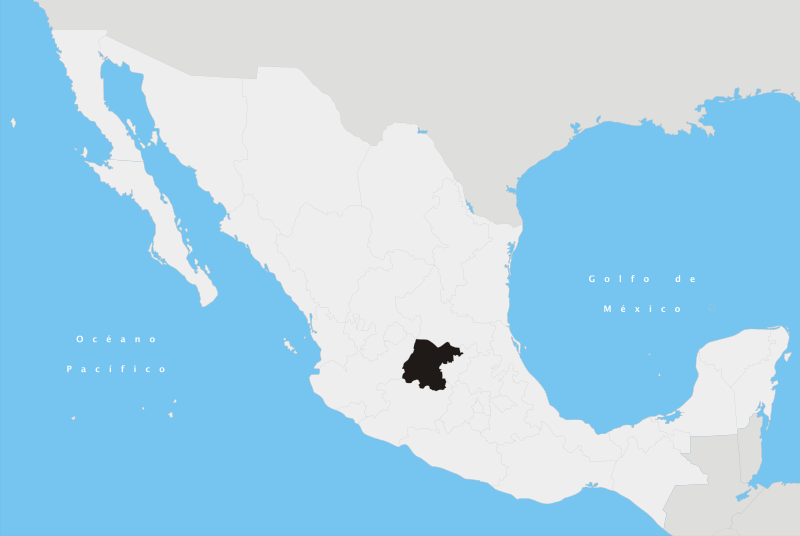
File:Guanajuato en México.svg
Photo from Wikipedia. Natural habitat of Cephalocereus in Central Mexico.


 The hair is used as protection from the sun in its native habitat in Guanajuato and Hidalgo, in Central and East Mexico. (See map for the location of Guanajuato. Hidalgo is to the right of  Guanajuato on the map.) 


It is also a secondary defense system against its enemies, the central spines it is hiding are the first.  The more sun your plant gets, the longer the hair grows, for more protection. The bad thing about having these hairy spines on the plant, is that you could overlook the fact that you have insects, such as mealybugs. They would be well hidden under the white hair. If the hair on your plant gets dirty, you can even wash it. Use a mild soap, such as Ivory dish soap and a soft brush, rinsing well. Check for bugs at this time. Its flowers may be red, yellow, or white but won't be seen until they are  10-20 years old and 20 feet tall. So, I'm thinking we won't ever see any in our homes.
In their native habitat, they are vulnerable to extinction. It is such a unique plant, it was harvested too much. Who wouldn't want this interesting plant? Now, its popularity has led to greenhouse growers producing it in large numbers. This will hopefully keep it from extinction in the wild. I love this plant and think it is so interesting that it grows its own sunscreen!


See the central spines sticking out among the "hair".
 In the picture above, you can see the spines and the areoles that they are growing out of.