Showing posts with label Madagascar. Show all posts

Tuesday, March 24, 2015

Madagascar Visited (At the Cleveland Botanical Garden)

Last Saturday, I headed to the Cleveland Botanical Garden to attend the Midwest Cactus and Succulent Society show and sale. I had never been to the conservatory there and so was doubly excited. I wasn't disappointed. They were having their Big Spring extravaganza, as well, so there was a lot going on. 

Green Euphorbia flowers
 I went to the cactus and succulent show first which I wrote about here, and then headed for the Eleanor Armstrong Smith glasshouse.
This conservatory was built in 2003 and has two distinct environments, the spiny Madagascar desert and the Costa Rican rain forest. 
The first room you come to, is the Madagascar desert room. 


Dracaena marginata


 As I started into the room I was met by an assortment of gorgeous plants.... and then as I looked to the left what should I see but these ENORMOUS cockroaches!!!!! Yikes!!!! Thank goodness they were behind glass!


Pandanus or screw pine

Euphorbia platycada


There were two "dead stick" plants hanging from the rocky walls. Euphorbia platycada and Cynanchum marnierianum.  Their way of not being eaten by hungry animals is to resemble something that is already dead. I have both of these plants in my collection at home. Love them!


Cynanchum marnierianum blooms


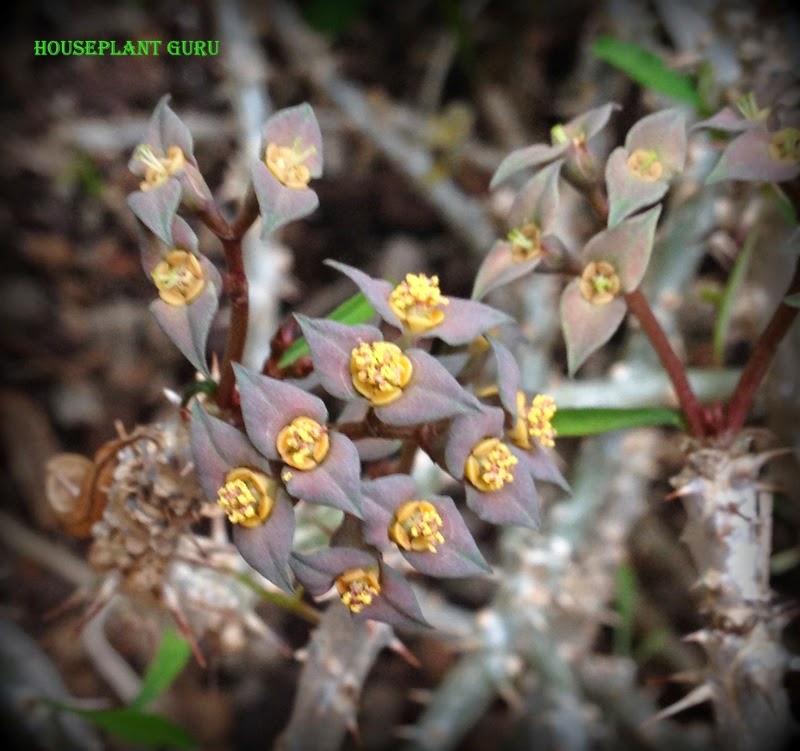
Euphorbia flowers


Also, in this room, are many different Euphorbias. Many of the plants in this room have a dormancy period. Most have no leaves at this time but as the Spring progresses they will wake up and grow leaves.
The picture below is the plant that the flowers on the left are from. I can't believe I even saw them. I was bending down taking a picture of another plant and saw these tiny flowers.


Pachypodium horombense
Caudex forming Pachypodiums are some of the many plants that can survive this harsh environment. The caudex holds large quantities of water for the plant to use during the dry season.


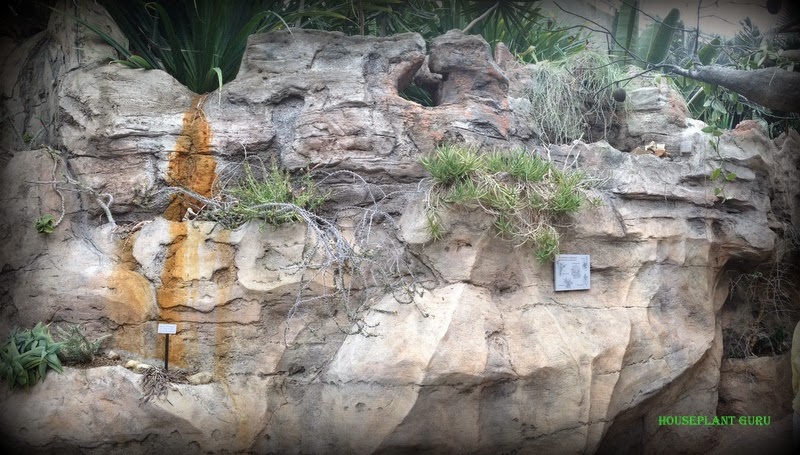
Cliffs holding many diverse plants
The area of Madagascar that is represented in this room, is the Isalo Massifs which is a mountainous region in Madagascar, an island off the coast of Africa. Enormous cliffs tower over the desert. In crevices in these sandstone cliffs an amazing array of plants are found that can endure the harsh winds and lack of water. These include many Euphorbias, Madagascar palms or Pachypodium lamerei and other unusual plants.

Pachypodium lamerei -right Euphorbia millii-top


Euphorbia


Euphorbia millii spilling down the cliff


Euphorbia decaryi


Faux Baobab tree
 The centerpiece of this room is the faux Baobab tree in the center. it supports many climbing plants and is a good rendition of a true Baobab. There are small real Baobab trees in the room. Sometimes they are called upside down trees because when the branches are bare, they resemble roots sticking out of the top of the tree.

A panoramic view of one side of the room.
Baobab tree Andansonia digitata


The young Baobab trees do not resemble their mature counterparts.


Dioscorea elephantipes
The large plant above is also called an elephant's foot plant. I think the whole caudex looks like an elephant's face. It is such an interesting plant. This caudex sticks out of the ground and a vine grows out of the top of it. When it is the dry season, it drops all its leaves and then grows them back when it rains.


Another caudex forming plant is the Adenia firingalavensis.
Below are the flowers of the Adenia.


Euphorbia flowers


Euphorbia flowers


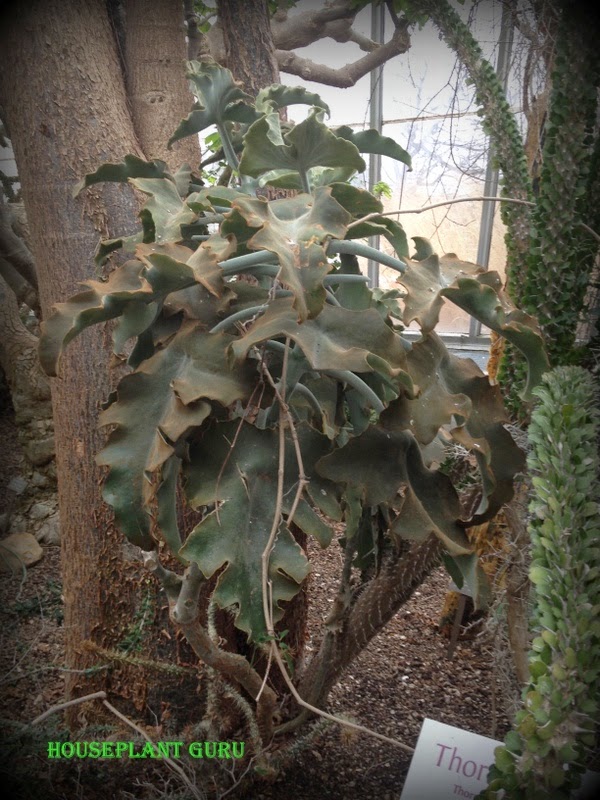
Kalanchoe beharensis
Radiated tortoise


They even have animals in this conservatory. This is a radiated tortoise. They also have a hedgehog and a chameleon that is roaming free, but I never saw it.


Euphorbia didierioides


This Euphorbia didierioides looks like it must be dead, but it isn't. It will wake up soon and grow all new leaves.


Close up of the Alluaudia


  The last plant I want to share is the Alluaudia. It is a very thorny plant with little leaves completely covering it. When it is dormant all the leaves fall off, but also grow back in the Spring.


I may never get to Madagascar, (and if those hissing cockroaches are roaming free, I'm not sure I want to) but I felt I got a little closer by visiting this conservatory. It was beautiful and the plants amazing.

Saturday, December 29, 2012

Star of Bethlehem

Angraecum sesquipedale - Star of Bethlehem
I love green so this orchid caught my attention immediately. I encountered it today at the Belle Isle conservatory in Detroit. I took a picture of the tag, so I could look it up. It is Angraecum sesquipedale, also called the Star of Bethlehem and Christmas orchid. What a romantic name for an orchid. It is star shaped and blooms at the time we celebrate the birth of Christ, so it is very apropos. It was discovered by a French botanist in Madagascar in 1798. It is also called Darwin's orchid as he theorized that it must be pollinated by a moth with a very long proboscis, which was found to be true, long after Darwin died. The long petiole-looking thing(very scientific language) at the top right of the photo is called a spur and the pollen is in the end of it. This spur can be between 10-16" long, so the moth had to have a proboscis that long. Darwin's theory was made fun of and its too bad he didn't live long enough to say "I told you so", to the unbelievers. In its native habitat, it blooms from June-September, but when grown here or in Europe, it blooms from December-January, thus giving it its common name of Christmas orchid. It has a lovely scent, so I've read, but only at night. Maybe I'll encounter one at night sometime and experience it first hand.