Showing posts with label Longwood Gardens. Show all posts

Friday, April 10, 2015

Fire Lily

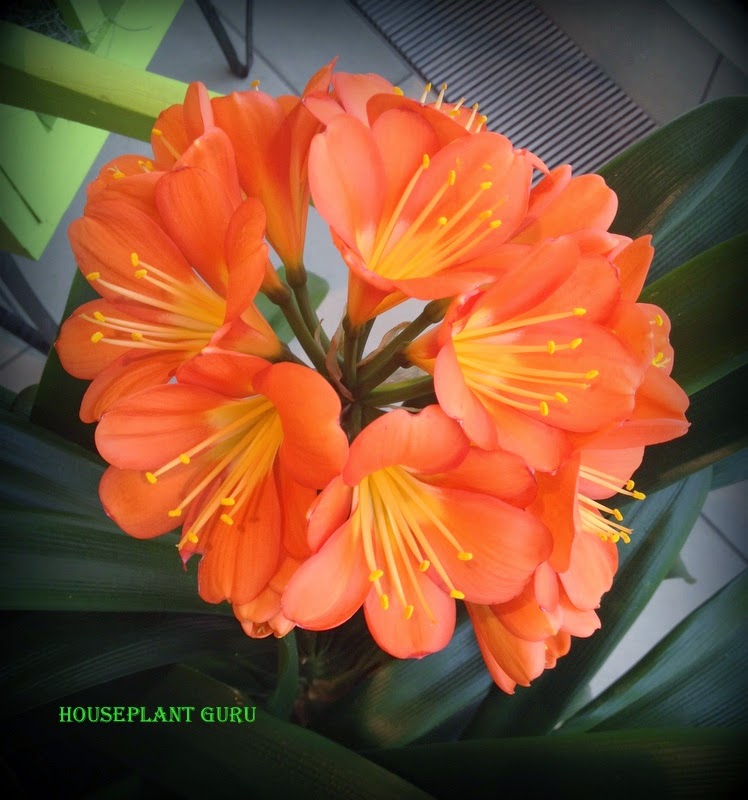
Clivia in bloom at Krohn Conservatory in Cleveland, Ohio
I have a Clivia blooming in my house, right now! Finally! I have had it for years and have been very disappointed that it has never flowered. I've heard everyone's tips and tricks for making them bloom, but it hasn't worked for me until this year. I was told that a cold, dry period would make it bloom, but I have a friend who has one in a sun room that is warm all the time and her plant blooms beautifully. Mine resides on the floor in my sun room which has an unheated brick floor. I didn't water it much this winter. Is this the reason it finally bloomed? I don't know. It's been in the same place for years but it finally decided this was the year. It was given to me by a customer at our nursery and I left it in the container it came in as I know they like to be root bound. It was staked and twist tied in a huge plastic pot. I really wanted to transplant it to a more attractive pot, but left it in the pot for the well being of the plant. Of course, I removed the twist ties and stakes, as it really didn't need it. I think they were trying to contain the size, but I just let it do its thing.
My Clivia on March 12th, 2015


My Clivia on March 20th, 2015


My Clivia on March 30th, 2015


Clivias are from warm, moist forests of South Africa. It has the common names of Fire and Natal Lily. The name fire lily is obvious, and the Natal lily is so called because it is from the Natal region in South Africa. The one you are most likely to find is Clivia miniata. Most have orange flowers, but yellow is also available. The yellow flowering varieties were very rare not so long ago, and very expensive. Now they are more available and definitely more affordable. They are in the Amaryllidaceae family, closely related to Amaryllis or Hippeastrum. The leaves look just like amaryllis leaves and they are both monocots. Monocots have foliage with parallel veins and include plants such as orchids, lilies, daffodils, iris, tulips, and cannas. Clivias are clump forming with dark leathery, long leaves and make  great houseplants, because they reside in the shade in their native habitat. To initiate flowering they must have bright light in our homes. They have very thick, fleshy roots and are best left undisturbed until they are almost breaking the pot. They hate to be re-potted and divided  and may not bloom the year after re-potting. Use a very well drained soil to replicate their native soil conditions. If the potting mix is kept too wet it will result in rot which will appear as pale green or bright orange cankers on the leaves. The Clivia would prefer to be on the dry side because of its fleshy roots. 
Clivia at Krohn Conservatory in Cleveland, Ohio
Where did the Clivia get its name. It was named by John Lindley of Kew in 1828 in honour of the Duchess of Northumberland, Charlotte Florentia Clive (1787-1866). She was born into a plant loving family and was one herself. The Clivia was first cultivated and brought into flower in Great Britian in her garden. The plant name should be pronounced with a long "í" (Clí-via) to commemorate her name. 
I'm still not sure exactly how I got my plant to bloom, but I'm not complaining, and hopefully it will bloom again next year.  


Close up of an individual flower


Yellow Clivia at Longwood Gardens, PA


This yellow Clivia is beautiful at Longwood Gardens. I had never seen one before. The yellow is gorgeous, but I prefer the orange. Then again, I wouldn't turn one down.


Variegated Clivia at Longwood Gardens, PA


Who wouldn't love the variegated foliage of this Clivia on the right. I wouldn't care if it never bloomed. While researching this plant, I found the site of the North American Clivia Society.There are some beautiful plants on their site. Check it out.


Clivia in bloom at Longwood Garden, PA

Friday, December 5, 2014

The Antlers on My Walls

Staghorn fern with the spores visible
Every Thanksgiving, we make the trek up North to mid Michigan to Mom's house for the holiday. This is, of course, during hunting season. Why does that matter, you ask? Well, its not bad getting there, but quite often on the way home, it isn't as pleasant. I understand that deer need to be thinned out and for this to happen people shoot them. I don't want them to starve over the winter. What I hate is the need for the deer to be hauled home on top of vehicles for all the world to see. It is disgusting and sad. I think maybe they want to show off their trophies. And, the bigger the rack (or horns), the better.
At an antique store


My nephew's mule deer


Platycerium bifurcatum


My brothers and nephews hunt, but the only deer horns I want on my wall are of the staghorn type! Staghorn fern that is!


Platycerium bifurcatum or staghorn fern is one of my favorite plants. Platycerium means 'broad horn' in Latin. The 'antlers' stand up and cascade and can be very impressive. These plants can grow to enormous proportions. There are many different species of these ferns and I have seen quite a few of these at different botanical gardens I have visited.


The most common species you will likely encounter is the Platycerium bifurcatum pictured here on the left.


Platycerium bifurcatum with spores on fertile fronds showing
These tropical plants are native to the Philippines, SE Asia, Indonesia, Australia, Madagascar, Africa, and America. They grow naturally as epiphytes on trees in the jungles. They are dimorphic meaning they sport two kinds of fronds. The first are the basal fronds and are often called 'sterile' fronds. They grasp onto the growing surface and usually are brown, starting their life as green, though. They become papery looking and feel that way as well. Their main function is to collect water, fallen leaves, and plant debris. The debris breaks down and releases nutrients to the fern. You can see them in the above picture (the brown part).
The other fronds are called foliar fronds and are the 'fertile' fronds. They can be erect or pendant and they produce the spores which are like seeds in that they are the way they reproduce. 
The silvery tint of the fronds is produced by numerous stellate (star shaped) trichomes [from Greek (tri khoma) meaning 'hair', fine outgrowths or appendages on plants] which are visible only under a microscope.
Platycerium wandae from New Guinea
Platycerium wandae at Longwood Gardens
Platycerium wandae or the Queen Elkhorn fern is the largest growing Platycerium and is from New Guinea. It can be 6-8 feet tall. 
Fronds hanging down on the Platycerium wandae
Platycerium superbum at Longwood Gardens

Platycerium superbum is also a very large fern and is from Australia.
Platycerium superbum


Platycerium superbum


Platycerium andinum or South American staghorn fern
Platycerium andinum refers to the Andes mountains in South America and there it lives in the dry forests of Peru and Bolivia. The biggest problem with this fern is overwatering. It does not like to be constantly wet. Crown of Angels is the common name.
Platycerium andinum with the spores on the fertile fronds showing


Notice the black sooty mold which grows on the honeydew


Staghorns rarely have problems, but occasionally, scale can be a pest on them. These pictures were taken at a botanical garden where it is especially hard to control insects, as it is a public place. The best thing to do is pick them off. Ferns are very sensitive to sprays, soaps, and oils. 


Platycerium bifurcatum with scale

Platycerium bifurcatum with scale

Notice the honeydew which is the excrement from the scale.


 So if you aren't so keen on having a dead animal with antlers on your wall, try one of these living works of art known as staghorn ferns.

Thursday, September 18, 2014

Tassel Ferns-Not Ferns at All

Lycopodium squarrosum at Matthaei Botanical Gardens
I first saw Lycopodium (Huperzia) in Elvin McDonald's book, The New Houseplant (page 45). It was a picture of a florist's window in New York with one of these plants hanging in it. There was nothing to tell me what it was, as it was in the background of the picture. I loved it all the same. The next time I saw it was at a local greenhouse and I parted with a lot of money and bought it. It was quite a large hanging plant. I hung it in my greenhouse, but unfortunately it was too hot, it dried out and I lost it. I was so bummed. 
So, the next time, I bought a small one, still expensive, and it is on my counter where I make sure it is watered and the humidity is high. I bought it last summer, and it has doubled in size. These aren't the fastest growing plants.
Though the common name would lead you to believe they are ferns, they are not. They are spore producing and are distantly related to ferns. The ones we are discussing today are epiphytic. There are terrestrial ones as well, but not as easy to grow. They prefer moist, humid conditions and do not tolerate drying out for long, thus the reason my first one is dead. The name Lycopodium comes from the Greek lukos, wolf, and podion, foot. They are also known as ground pines or creeping cedar.

My lycopodium.
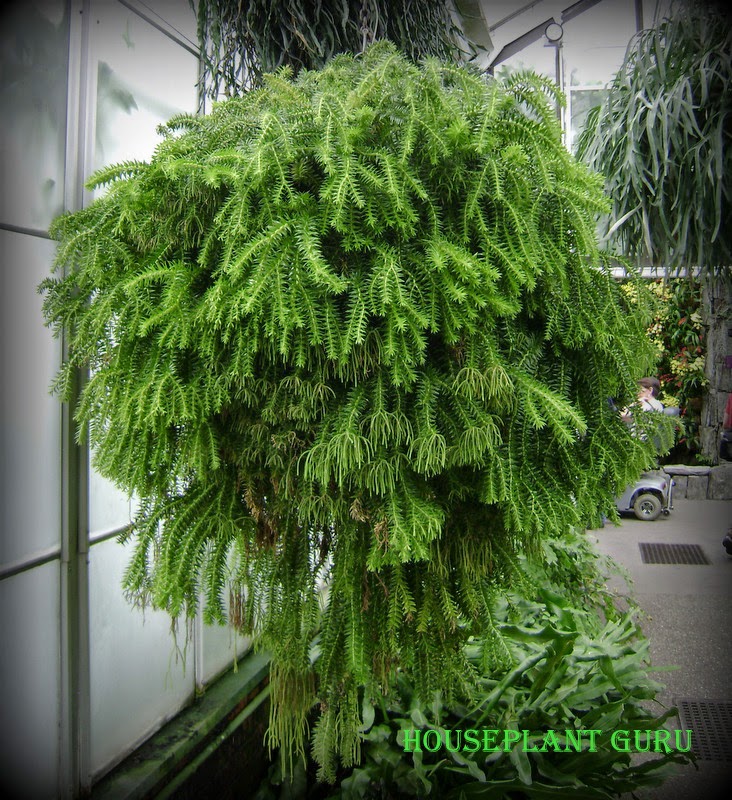
  Imagine my excitement when I walked into the fern corridor at Longwood Gardens in Pennsylvania. ( I was already ecstatic just to be there!) I was amazed to see these enormous specimens hanging from the ceiling. Wow! The following are pictures of those.


Lycopodium carinatum


The next time I saw Lycopodiums was at a friend's greenhouse. He had 3 different species and I love them! The pictures of those are below.
Lycopodium nummulariifolia
Lycopodium phlegmaria
Lycopodium carinatum
I have seen varieties of these for sale at the orchid shows. If you have a chance to own one of these, don't pass it up. I think they are amazing plants and I would be thrilled if mine even remotely looked like the ones at Longwood someday.

Friday, April 13, 2012

Longwood Love


Pride of Madeira in display house.
I'm in love...with John of course, but also with Longwood Gardens. I was lucky enough to visit when I drove to New Jersey to help pack my daughter up, and move her back home. Yeah! for that, too. But, back to Longwood. Four acres under glass=heaven! That's where I really was for 7 hours~heaven! I took over 900 pictures ( I won't bore you with all of them...) and was literally almost the last person out the door. I could live there. I'd like to live there.
The conservatory had its annual orchid display in full swing.
Topiaries of orchids.....

Orchid topiary.

Arches of orchids.....

Arch of orchids.

Floating orchids......


Floating orchids.


Rooms full of orchids. Orchids everywhere!


A wall of orchids.


I attended a seminar in this orchid display room, given by Maria, the keeper of Longwood's 9,000 (yes, I said 9,000) orchids. They are kept in 5 greenhouses, each with its own climate. All the orchids in this room are here for display purposes, not growing purposes. They all have different needs, thus the reason for 5 different greenhouses, each with a different climate. These are happy orchids! And beautiful!


Phalaenopsis


Cymbidium

x Laeliocattleya g. 'Trick or Treat'
Phaphiopedilum g. 'Golden Slipper'
Miltonia
x Potinara g. William Farrell 'Apricot Orange'


The fern walkway is also beautiful. I love ferns and they have some fabulous ferns. I don't think I've ever seen such huge, healthy ferns. 
I especially love all the lycopodiums. Lycopodiums are actually club mosses, but grow in the same conditions as the ferns, so they coexist happily.

Lycopodium carinatum


The "footed" ferns look nothing like mine. Mine are babies compared to these giants hanging from the ceiling.


Vine Fern-Stenochlaena tenuifolia


Hare's Foot Fern- Plebodium aureum 'Crispum'


Up close to see the "feet".


There were also some great staghorn ferns. I didn't know there were this many different varieties. They are just monstrous and so unusual.
Platycerium superbum

 
Platycerium wandae
Close up of the center of the fern.

Fiddlehead.
 There was so much more, but I don't want to make this the longest blog post ever. I told you I took 900 pictures. The orchids and ferns are enough for now. I've barely even covered an acre at this point. There are bromeliads, roses, hibiscus, tropical rooms, and the children's area. This doesn't even cover the over 1,000 acres outside. I love this place. If you go, you'll fall in love also.