Showing posts with label houseplants. Show all posts

Thursday, January 15, 2015

Well, This is Embarrassing!

The state of this rhizamatous begonia is embarrassing! (This is what comes of having too many plants!) It has been residing in my bedroom for a  very long time. Today the bedroom received a  thorough cleaning, as a new bed was delivered. I put all my plants in the shower to clean and then I took a good look at this sorry looking plant. It used to be so full and gorgeous and has been slowly going down hill. It is above my view on a shelf, so I had not looked into the pot in quite a while. Yikes! 
Soooo, I brought it downstairs to not necessarily "up pot" it, but to just "re pot" it in the same container and add some much needed soil to the top. I wouldn't normally suggest that a plant be re-potted at this time of year, but it was necessary. March or April would be a better time here in the North.


After plants have been in the same container for years, they can need more soil, as the old soil breaks down. When you have a plant in a large container and don't want to re-pot it, something called topdressing can be implemented. That involves just adding some soil to the top of the plant, especially if the roots are showing, as in the picture above and below. This can also include smaller plants, as the one here.  You can see that the soil is down to my second knuckle. This is only a 4" pot.


The rhizomes in the middle of this plant are all dead so I removed them.


Roots showing as the soil is depleted


After removing them, I added soil to the bottom of the pot to raise the plant depth and just enough to the top to cover the exposed roots. It is okay to add soil to the top of your plant if it is depleted and the roots are showing, but never bury the plant too deep or it could result in root or stem rot and even the death of the plant.


The container was very dirty and I cleaned it before re-potting the begonia.


 I added fresh soil to the top of the plant.


I  probably should have cut off this flower bud, but I couldn't.
When a plant is struggling or newly re-potted, it would be best to take the flower buds off so all the energy of the plant is used to grow new foliage and roots. "Do as I say, not as I do," as the old saying goes.


This picture on the right is a close up of the tip of the rhizome and it also has a flower bud coming. It looks mushy, but that is just moisture, as I watered it after re-potting.
Make sure you inspect your plants often, and you won't end up with an embarrassing plant such as this one.


Monday, July 21, 2014

More Astrocities Done to Plants

 
Money tree glued down

How many of you have bought plants that have pebbles glued on top of the soil? I hate this. I realize it is done for ease of shipping. The soil stays put, the plant stays upright. It's all good. And to add insult to injury, the containers they are in are usually without a drainage hole. I  recently bought a Pachira or money tree after Father's Day.  It was 1/2 off -I couldn't pass it up!


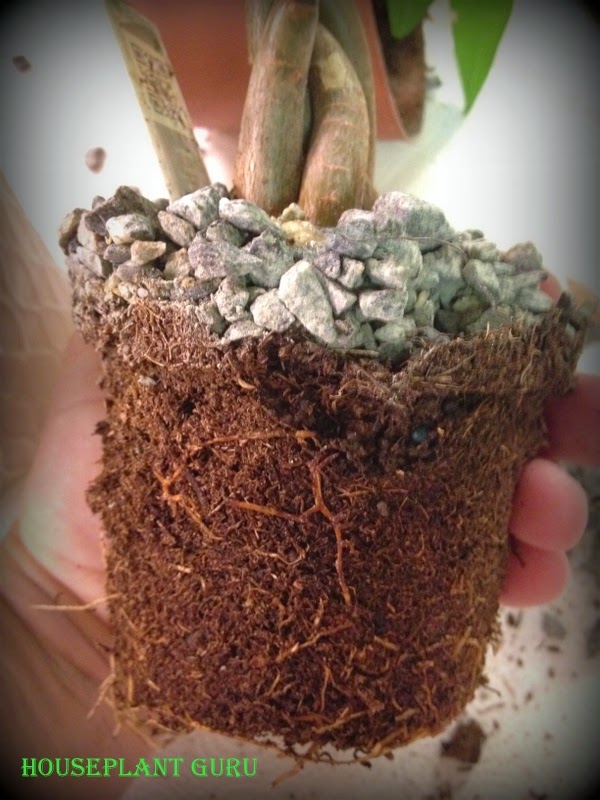
Pachira out of the pot with stones still attached

So my question is-how would you know your plant needs water. You certainly can't stick your finger in the soil to check for the plant's water needs. Or how would you know if it has too much? You can't look inside the pot.
So, where to begin? First, I chiseled the plant out of its pot. As you can see above, the stones are still intact on top of the root ball and around the stem.


Second, I pulled the glued stones from around the stem. I was as careful as I could be, but as you can see in the above picture some of the bark of the Pachira tree was also removed from around the stem.


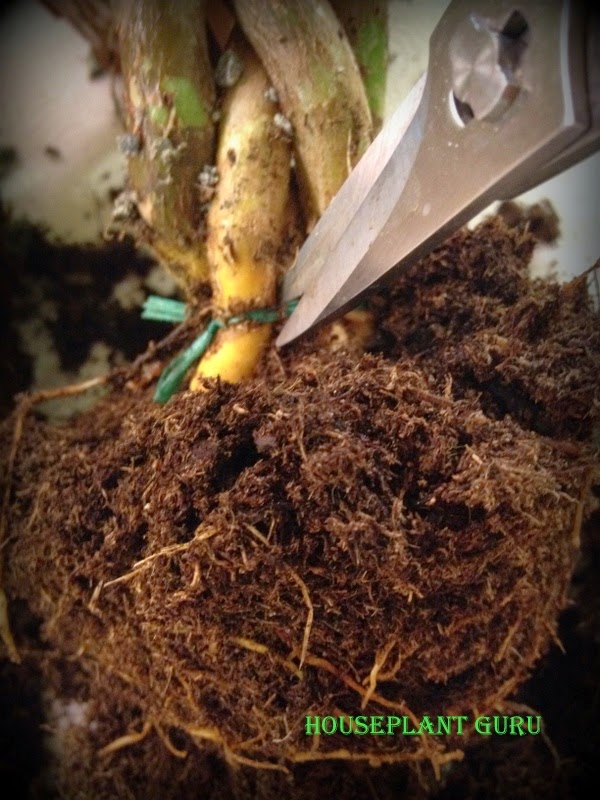
After removing the stones, I realized how much soil was around the stems. The soil was way too high up the trunk. After removing the superfluous soil, I found a tie around the stems. When they braid the stems, they need to be tied to stay and grow that way. That is necessary, but as you can see in the pictures below, the tie was cutting into the stem. I'm not sure how long it would have been before this tie girdled the tree and killed it. Would we think out plant just died, or think we had done something wrong? When all along, it is being slowly strangled. Had I not removed the rocks and the soil that were too high on the stems, I would never have know the tie was on there, slowly killing my plant.


So, to help the plant live, I cut the tie so it could "breathe". I think it felt like I do when I take my belt off at the end of the day.


As you can see in the pictures above and below, this plant already has damage from the too tight band.


Even the tag is glued into the rocks.


Lastly, I drilled a hole in the container it came in, added new soil and replanted it. I know it is going to be a much happier plant! So if you see one of these plants and really want it, it isn't a terrible job to get the glued rocks off and re-pot the plant. You may just be saving the plant!

Friday, February 14, 2014

Houseplant Homes

Bunco prize
I have a lot of houseplants. Big suprise, right? So, consequently, I have a lot of houseplant containers as well. I usually use green pots, but sometimes I like to decorate my own. The container above is one I make quite often and this month I made these for my bunco prizes. 


It was February so I definitely had to paint hearts. I also added a verse as this was my church bunco group. My gift theme was plants and so this was my verse:

Jeremiah 17:7-8

New International Version (NIV)
“But blessed is the one who trusts in the Lord,
    whose confidence is in him.
They will be like a tree planted by the water
    that sends out its roots by the stream.
It does not fear when heat comes;
    its leaves are always green.
It has no worries in a year of drought
    and never fails to bear fruit.”

I added a little extra something with these painted stakes made from knives I purchased at the Salvation Army, which I call plant jewelry.


Here are a couple more pots I painted. One I made with buttons and the other with stamps called Design Presses that I've had for years.

Button flowers
Pansies-my favorite


The key to painting clay pots is sealing the inside of the pot. I simply use Modge Podge for the sealant and acrylic paints for the decorating. I seal the inside and when I'm done painting the outside, I seal that as well. The buttons were glued on with E-600 glue. I painted pots like these for teacher gifts many years ago. After spending a lot of time painting them and then planting them up with pansies, I watered them. The next morning the paint was bubbling off the pot. Clay pots are porous and so the water seeped through the pot and pushed the paint right off. I was so upset. Needless to say, the teachers did not get hand made gifts for the last day of school.
So next time you decide to re-pot some houseplants, decorate your own pots or at the very least, paint them a color which matches your decor. This is something kids would love to do also. Have some fun!

Friday, January 24, 2014

Praying Mantis are In the House- Greenhouse That Is!

The little praying mantis emerging from the egg case

A picture further away so you can see the size


I'd noticed this praying mantis egg case on my Euphorbia platycada in my greenhouse, but couldn't believe that's what it was. I've seen egg cases at work, on the plants in the nursery, like burning bush and viburnum, but on a houseplant?! How did a praying mantis get into my greenhouse, which is attached to the house. I've never seen one in there, but obviously I  missed it.


One crawled into the pot next to the Euphorbia


The egg case is about the size of a ping-pong ball. I found one at the nursery (we own an IGC) and showed John and he told me what it was. I didn't really believe him and threw it in the trash can. The next day, we had praying mantis babies all over the office.


This one is an acrobat.


The problem with this whole situation, is that they wont' have anything to eat. Of course, they will probably eat each other. Yikes!


It was fun to watch them emerge from the egg case, looking just like their parents only much smaller. I think they are the cutest things!


Full grown praying mantis last summer on my garbage can in the garage.

Saturday, January 18, 2014

Plants Are Therapy


Book by Elvin McDonald co. 1976

Okay, I’m not suggesting that you cancel your therapist appointment or stop taking your anti-depressant, but plants can help with the everyday stress we all have. I have a magnet on my refrigerator that reads “I most often find that happiness is right where I planted it.” 


That is so true! My favorite thing to do is groom my houseplants; repotting them, cleaning them, and pruning off any dead leaves. It’s a soothing, rewarding hobby (obsession?) for me. What can plants do for us, other than provide food, shade, oxygen, and clothing? Plants can improve moods, make one more productive, and relax us.

Does this all sound too good to be true? Does it sound like a bunch of mumbo jumbo? Well, I’m not making this up. People go to college to get degrees in Horticultural Therapy. Michigan State University gave the first undergraduate degree in Horticulture Therapy in 1955. Where did this concept come from? In the late 1950’s, Alice Burlingame established horticultural therapy programs with volunteers from garden clubs, and taught classes at the Pontiac State Hospital for their employees. The American Horticultural Therapy Association defines horticulture therapy as, “a process utilizing plants and horticultural activities to improve social, educational, psychological, and physical adjustment of persons thus improving their body, mind, and spirit.”


How many plants and flowers have you taken to people in the hospital? It’s the normal practice, but why? If you’ve ever been in the hospital, you know that when visitors arrive with plants or flowers, it brightens your day. Many hospitals now have beautiful atriums filled with plants where patients and their families can go to relax, recuperate, and meditate. 

University of Michigan atrium


 When I had surgery at the University of Michigan Hospital, I was wheeled down to the atrium many times. Hospitals are so white and sterile and cold. Going to a place filled with the sound of water, the green of plants, and the aroma of soil made all the difference. It made me feel at home, and many other people were there enjoying it as well.  Of course, my friends filled my room with plants (not cut flowers) as they know I can’t live without a plant or two (or 500) around me. 


U of M atrium


Hospital plants or therapy as I saw it.


Hospital plants


Hospital plants and a bird too.


Atrium at Henry Ford West Bloomfield hospital

 The new Henry Ford Hospital in West Bloomfield also has incorporated a beautiful atrium into its newly built hospital. I talked to Rebekah, the Director of Public Relations, and she informed me that it contains over 3000 plants and was installed as a place for people to visit and relax in. The hospital has also installed a greenhouse on the grounds where they grow vegetables and herbs hydroponically for use in their restaurant and inpatient food program.  Horticultural therapy is also practiced in the greenhouse with some patients.


Henry Ford hospital atrium


While visiting New York this spring, my daughter and I visited her friend living in Brooklyn. She had left friends and family to start a new job. She had one small plant in her apartment and we joked about the fact that she would call out to it when she walked in the door, “Honey, I’m home!” Everyone needs another living thing to talk to, even if it is a plant. Of course, while at the New York Botanical Garden, I bought her another “friend”. 

New York Botanical Garden gift shop


 As a young mother with a husband working 60-80 hours a week, I found that I needed to get out of the house and interact with other adults. I found a local garden club, of which I’ve been a member for over 20 years. Joining a garden club or plant society brings like-minded people together to discuss their gardens and plants. I have made many new friends by becoming a member of these groups. They usually meet once a month and I look forward to these evenings spent talking about plants with people who are as crazy about them as I am, and sometimes even more so, if that’s possible. One of the many programs my garden club is involved in is a program called Garden Therapy. The members of the garden club go into the special needs classrooms in the Farmington Hills area and make a craft with the children once a month. These crafts always incorporate some form of plant material.  It is a rewarding project for the members and the kids get so excited when they see the “garden ladies” coming.

Corner of my greenhouse (Makes me happy)

Plants in your home are like infants. They depend on you for all their needs, including water, fertilizer, and light. If you take care of their needs, they will reward you with healthy new growth. If they are neglected, they will be dusty, diseased, and probably infested with pests. There is nothing sadder than a poor, dirty, neglected, sick plant. I’ve encountered many of these, mostly at restaurants, and offices and even in people’s homes. Little do they know that that taking care of these plants would probably make their lives more fulfilled and happier, say nothing about the way their plant would feel. Many studies have been done, proving that plants can reduce stress and anxiety, improve moods, improve your sense of personal worth, and increase the sense of pride and accomplishment. All this being said, why wouldn’t you want to try growing a plant? Whether it’s at home or on your desk at your office, nurturing a plant, can in turn, nurture you!

Sunday, January 5, 2014

A Love for the Crown of Thorns


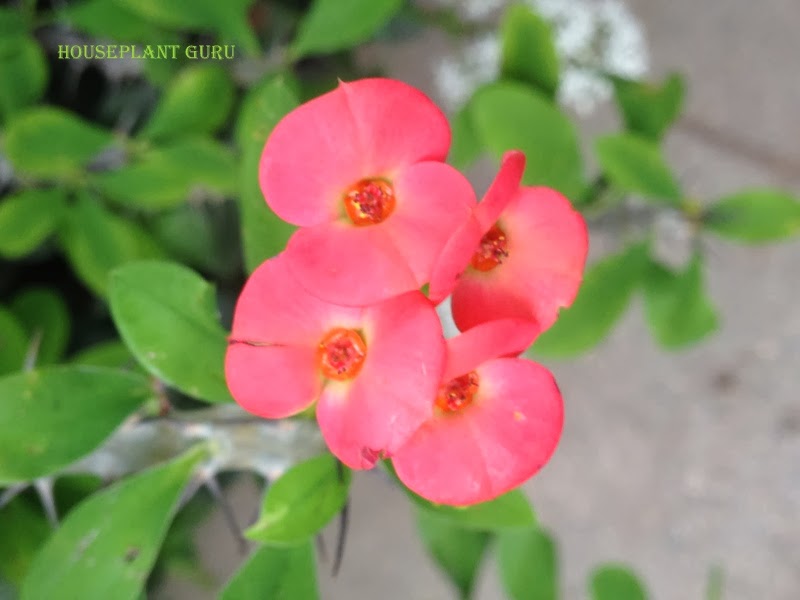
Pink bracts surrounding the yellow flowers.


I have a lot of plants. There are  a few varieties that I have  collections of and Euphorbia is one of them. Today I'm going to talk about the crown of thorns, Euphorbia milii  and the others in the collection another day.
The first 3 pictures are of a very large Thai hybrid I've had for quite some time. When I bought it, it was in a 6" pot and only about 10 inches tall. Now its over 4' tall . It also had huge hydrangea-like flower  clusters when I bought it. They still are large flowers, but I've never had a cluster that large since. For clarification, the flowers are the small yellow round things in the center and are called cyathia and the colored parts are called cyathial bracts, which are modified leaves. 

I found these pictures below of the same plant from 2002. I entered it in a local flower show and won a blue ribbon, as well as an award of merit. You can see how small it started out and now it is over 4' tall.
The crown of thorns above in 2002
I won a blue ribbon and an award of merit

My first experience with crown of thorns was in 1983. I was in the 11th grade (yes, I'm dating myself) and was lucky enough to go to Washington, D.C. on a school trip. I was with another girl from my class and talked her into going to the U.S. Botanical Garden. I loved plants even back then, and she was a great sport to go in. I saw a plant that was just gorgeous, covered with little red "flowers" and I thought it was amazing. I'm not sure when I figured out what it was. When I saw one  for sale, I snapped it up. I actually found the picture I took of it in an old photo album. I was a plant geek way back then and still am.

Crown of thorns at U.S. Botanical Garden 1983

Euphorbia 'Pink Cadillac'


This is a newer variety called 'Pink Cadilllac' It is a very full, compact, floriferous variety.


Euphorbia 'Fireworks'


This variegated form is called 'Fireworks'. I love variegated plants, so when I saw this, it was a must have. It hasn't flowered, but variegated plants never bloom as well, and that's all right with me.


.


Euphorbia 'Northern De Lites'


  A dear friend  gifted me with this plant just a few months ago (thank-you, Julia!). I love it! It is the cultivar 'Northern De Lites' and although variegated, it is much different  than the 'Fireworks' variety.


Unknown cultivar at a cactus meeting


This was a plant someone brought for "show and tell" at cactus club. I don't know the cultivar, but it is gorgeous.


Crown of thorns at Belle Isle


Very old spiny plant at Belle Isle Conservatory
We were at the Belle Isle Conservatory in Detroit yesterday and these plants were both in bloom. They are very old and spiny.


These flowers are only 1/4" across.


This picture above is of my miniature crown of thorns. I don't know the culitvar, but the flowers are only 1/4" across. I've had it for years and the plant is still only about 10" tall.


I have these two crown of thorns from Proven Selections. My 'Cherry Cobbler' has bloomed but the 'Lemon Meringue' hasn't bloomed yet. The 'Cherry Cobbler' bloom is below. People always love plants that are named after food (it is a proven fact). These make me want to bake a pie! I can't wait for the yellow one to bloom. These cultivars are only a couple of years old.


'Cherry Cobbler' Crown of Thorns from Proven Selections


Plant people have been working to make the crown of thorns have much larger bracts surrounding the small yellow flowers. They come in yellow, pink, red, and bi-colors. They are very easy to take care of which is a huge plus. They usually drop their leaves on the bottom, only growing new ones on the top. A lot of mine have leaves and flowers on the top and very spiny stems on the bottom. They are not spines like those on cactus because crown of thorns aren't cactus, but succulents. There are no areoles around the base of the thorns which would identify them as cactus. Cactus spines are modified leaves. The spines on crown of thorns are called stipular spines and grow at the base of leaves.  
Water them and then let them dry out quite a bit before watering again. Give them a bright window if you would like them to flower.  Euphorbia milii are from Madagascar and are said to be the thorny bush used for Jesus' crown of thorns, thus the common name. They are easy to propagate by cuttings. Use approx. 3" cuttings, letting them heal over before potting them up in soil. Euphorbias have a sticky, white sap that is evident when you cut the plant. It is  latex and it is advisable not to get it in your mouth or eyes.
When you need to re-pot them, be very careful, as they are very spiny and it can be very tricky. When potting thorny plants, I use leather gloves or strips of newspaper, a strip of carpeting, or tongs to hold the plant.

'White Lightening' Crown of thorns


This very white variegated crown of thorns was at Longwood Gardens in Pennsylvania. It looks a lot like 'Fireworks'. 

The next time you see a crown of thorns for sale, buy one. It is an easy, unusual, beautiful plant to grow.