Showing posts with label Davallia fejeensis. Show all posts

Friday, October 31, 2014

Scary Plants

Today is Halloween so I decided to mention a few plants that have names that conjure up thoughts of evil or actually are kind of evil.
The first one is the carrion flower or Stapelia gigantea. Its flowers actually smell like carrion or dead flesh, thus attracting its pollinator, the fly. As you can see from this picture a couple of flies have been lured to pollinate this flower. Yuck!
Carrion flower or Stapelia gigantea
This next plant is called devil's backbone. As you can see at the bottom of the picture, the stems are definitely not following the "straight and narrow" path. It is commonly called the zigzag plant, as well.
Devil's Backbone Pedilanthus tithymaloides
This is the green worm or caterpillar plant. I love the footed ferns and have blogged about them here: Ferns with Feet.
Polypodium formosanum or green worm fern

Polypodium formosanum rhizome up close
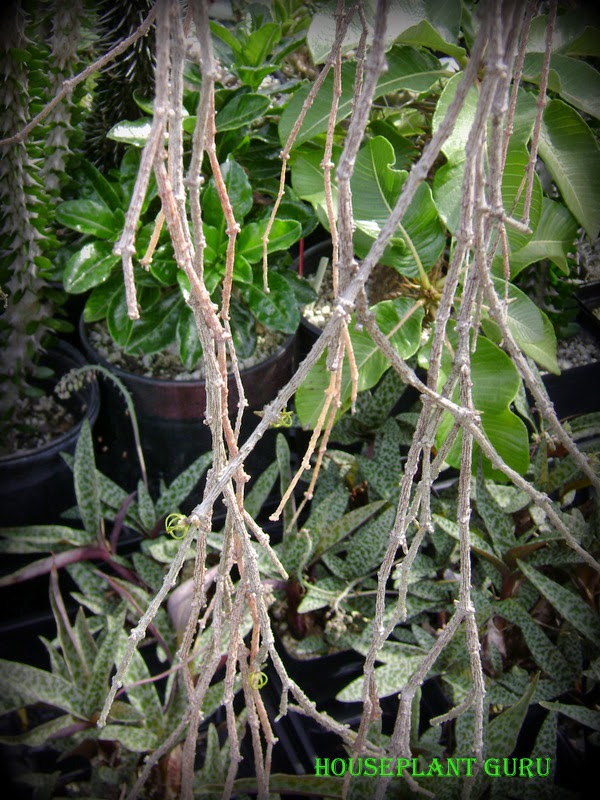
This plant below is the dead stick plant and it is a hanging succulent. It does look like a dead stick. It is Cynanchum marnierianum.

Cynanchum marnierianum or dead stick plant
 Another dead stick plant is Euphorbia platycada. I love the color of this plant in the sun. Plants that resemble dead sticks are just trying to stay alive. Most herbivores don't want to eat a dead stick. Pretty intelligent plants, huh?
Euphorbia platycada or dead stick plant


Chlorophytum comosum


 Everyone knows about the ubiquitous spider plant or Chlorophytum comosum. It makes new babies which hang off the mother plant by long stems, resembling little spiders hanging from webs, thus the name.


The next plant is the rabbit's foot fern or Cynanchum marnierianum. Why do I have this plant in the scary plant category, you ask? Because my sister-in-law turned around in her chair while having dinner at my home and this plant was behind her. She shrieked, thinking it looked like some kind of tarantula leg or something. Lol! It is pretty creepy looking.

Davallia fejeensis
The crocodile fern or Microsorum musifolium 'Crocodyllus' is up next. I wouldn't want to mess with a crocodile, would you? This close up of the leaf makes it obvious how it received its common name.
Microsorum musifolium 'Crocodyllus'
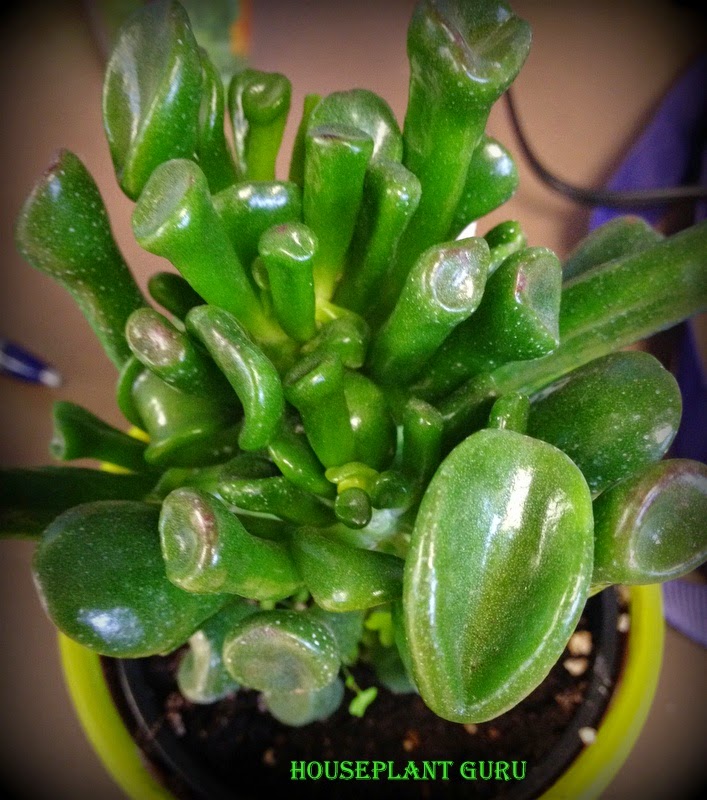
I call this "Shrek's ears" but it is really a jade, Crassula ovata 'Gollum' . We just had a fall fun festival at our nursery and the each child that came could plant a spider plant in a chalkboard pot or these "Shrek's ears" in a green pot. They loved it. Check it out- they really do look like Shrek's ears.

We also all are familiar with Sansevieria - snake plant or mother-in-law plant. You may think both names apply. (Not to my mother-in-law. She's the best!)
Sansevieria or snake plant

 Another slithery plant is the rattlesnake plant or Calathea lancifolia. I guess the pattern on the leaves and the long thin shape made someone somewhere think of a rattlesnake. Not me.
Calathea lancifolia
The next plant is called devil's ivy or Epripremnum aureum and the cultivar I have is 'Neon'. Why do a lot of plants have a common name with devil in it? That may be a blog for another time.
Epipremnum aureum 'Neon'


The stag horn fern Platycerium superbum below doesn't really have a scary name or anything. I just thought this one looks like it has a huge mouth coming out to eat someone.


The last one I have to share with you is this bonsia with a little gargoyle caught in its roots. I love it! I hope you have a Happy Halloween and enjoyed these "scary" plants.


Saturday, December 31, 2011

Ferns with Feet


Davallia fejeensis rhizomes up close

Notice the shallow pot.

Rabbit's foot, bear's paw, kangaroo paw, green worm. What do all these names have in common? They all describe types of "footed" ferns. The "feet" are really rhizomes that creep and crawl across the top of the soil surface, sometimes even covering and surrounding the pot. Of course, they may be crawling across rocks or some other surface. I had a rabbit's foot fern on a Hawaiian rock, but it unfortunately contracted a horrible case of scale and now resides in the trash. These ferns are quite susceptible to scale. They can be treated, but I decided it wasn't worth risking my other plants, and so got rid of it. 
My rabbit's foot fern looks the best of the four types of these ferns I have. It is in a shallow container, and that is all the soil it needs. The rhizomatous ferns have shallow root systems. They creep along the ground or over rocks in their native habitats. They will all thrive in moderate to bright light. Mine are in an East window and are doing well.  Obviously from the picture, you can see the kangaroo paw fern isn't doing quite as well. It looked great when I bought it, but has gone down hill since. I've re-potted it and am hoping it turns around.


Top view of rabbit's foot fern


These ferns come from South East Asia, Japan, and Australia. The rabbit's fern comes from Fiji, thus the botanical name.  They can be epiphytic or terrestrial, they like high humidity and bright, filtered light, and  need well-drained soil. Never let them dry out too much. I have done that to my caterpillar fern and it loses some leaves, but comes back just fine. Of course, I don't recommend this, but I think the rhizomes hold an extra amount of moisture, and this feature has saved my plant more than once. They really want to stay evenly moist. They are great plants for hanging baskets, as their "feet" can be seen better from below. I have mine on plant stands, so they are visible. 
They are able to be propagated quite easily. They can be separated or started from a piece of rhizome. Cut a piece of rhizome away from the plant, making sure it has a frond attached to it. Lay the rhizome on top of the soil surface and pin it down to the soil to keep it upright. Keep it moist and it should root and take off creeping across the soil in no time.

Caterpillar fern~Polypodium formosanum
The caterpillar fern is also called the worm fern, the E.T. fern, and the naked rabbit's foot fern. This is a good example of why the Latin name should always be used to identify your plants. These are four names for the same plant and there may be more. If I identify it by using the Latin name, Polypodium formosanum, there will never by any question about which plant I am referring to.


Top view of Polypodium formosanum

Polypodium formosanum up close
This is the kangaroo paw. It was very beautiful and full when I bought it. It is looking better now that I've re-potted it, but still has a lot of recovering to do.
Kangaroo Paw~ Microsorium diversifolium


These pictures of the bear's paw fern, are from Phipp Conservatory. My plant is young, and the rhizomes aren't very prominent, so I used these pictures instead. The Phipp Conservatory is a wonderful place, by the way. I didn't have much time there, but could have spent all day.


Bear's paw fern~ Aglaomorpha meyeniana
Bear's paw fern at Phipp Conservatory in Pittsburgh
Try one of these unusual, interesting ferns. They aren't your run-of-the-mill ferns and they can be a real conversation piece. They are great plants for children also. They can't help but be interested in fuzzy, wormy-looking plants. Who wouldn't be?